BACK
Coinbase
Jan 25
Mobile + web
Launching direct deposit
Overview
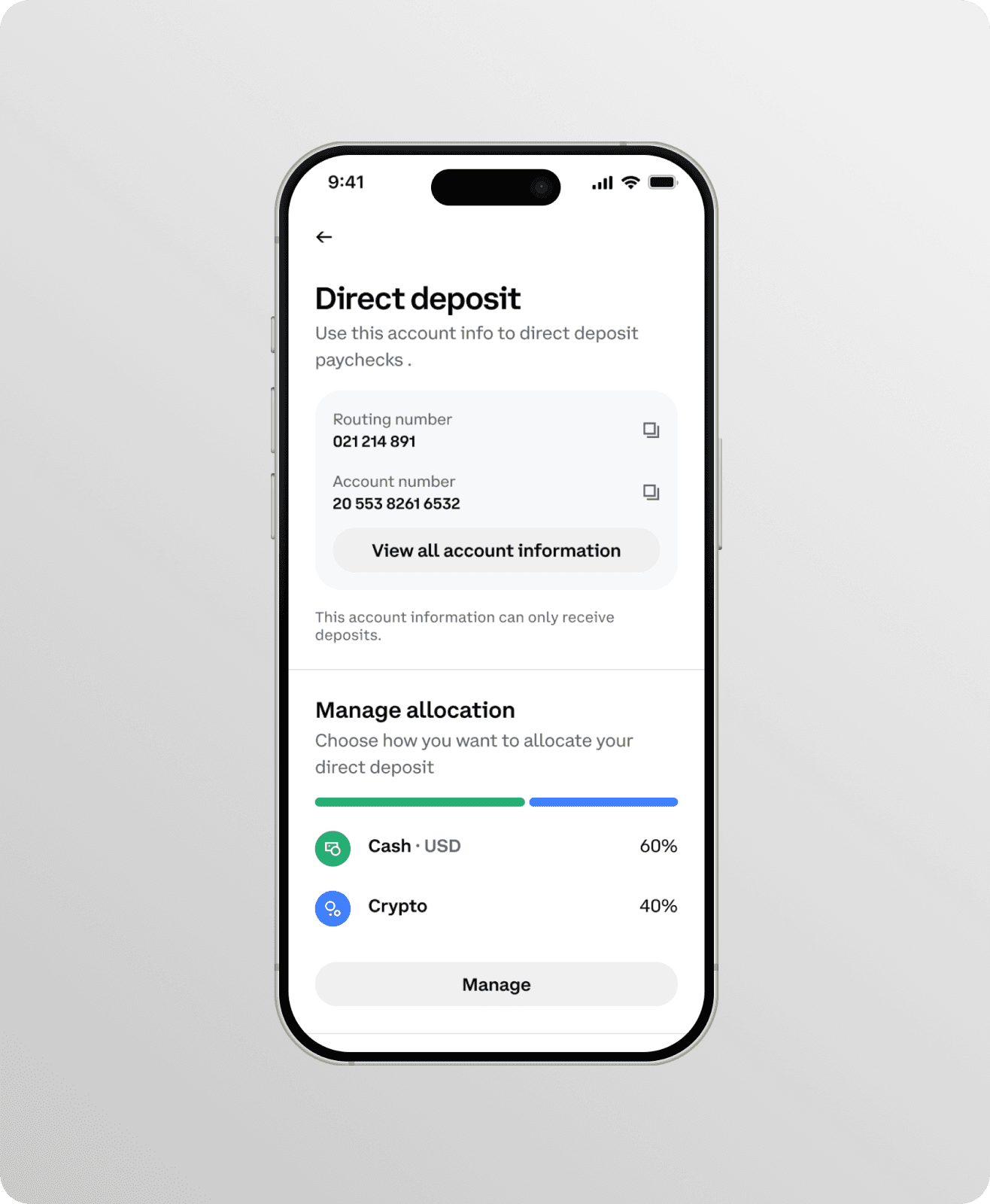
Direct Deposit lets users route some or all of their paycheck from their existing payroll provider straight to Coinbase. Funds can land as cash (USD or USDC) or be automatically allocated into crypto — turning every payday into a recurring, hands-off entry point onto the platform. Set it up once with an account and routing number; it runs on its own from then on.
Strategically, it's a step toward Coinbase becoming a user's primary financial account. Today the checking account is the middleman — paycheck flows employer → checking → Coinbase — and that extra hop creates hesitation about moving more money onto the platform. Direct Deposit removes the middleman: when the paycheck lands here first, Coinbase becomes the checking account in the user's banking picture. That's exceptionally sticky — once a user sets it, inertia keeps it in place. The hard part is getting users in; once they're in, they're high-value and trade more, because we've effectively taken them on as their PFA.
Problem
Getting money onto Coinbase was a manual, repeated decision — users had to actively choose to deposit every time. A legacy direct-deposit option existed but was primitive: it accepted cash and little else. Nothing connected a paycheck to a user's actual investing intent, and there was no automated path from income → cash → crypto.
Research & Discovery
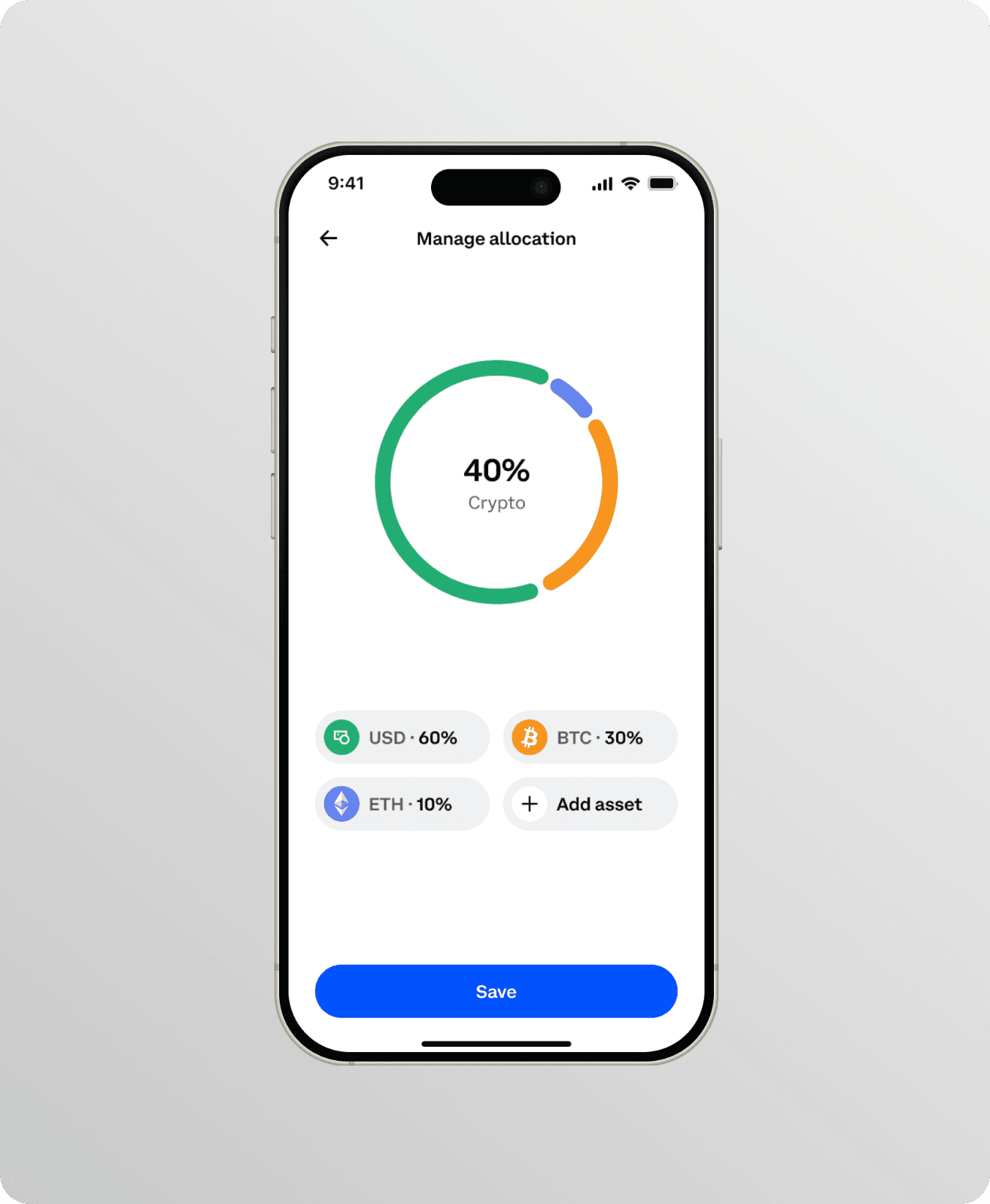
Users keep allocation simple. On average they split a paycheck across ~1.5 assets — mostly Bitcoin, occasionally ETH or Solana, rarely anything further out like meme coins. This became the north star: don't build complexity users won't use. It's the constraint the entire allocation experience was designed against.
Strategy
Anchor allocation to the 1.5-asset metric
Cash-first model: the paycheck always lands as cash; crypto allocations are deducted from that 100%.
Default to assets the user already owns or has available, lowering the decision cost.
Make the consent moment legible so users clearly understand they're authorizing a new bank account.


Entry Points
Shipped:
"Deposit" quick action button on Home Tab and Cash Tab.
Cash context — a banking "chip" surfacing the bank icon and last four of the account number. (added a coach mark for new users)
“Add Payment method” + “More” / overflow menu.
Planned:
A "Do more with your cash" section on the Cash tab (part of the Cash Tab redesign) that would include a clear card style entry for Direct Deposit
Core Journey
Setup → user adds a Coinbase account + routing number into their payroll provider, gated by a clear consent flow for the partner-bank account.
Allocation → a Cash App–style wheel. Add an asset and it enters at 10% by default, deducted from cash (100% → 90%). Adjust freely; cash floors at 0%, at which point allocations cap and require manual rebalancing. Explored dial and slider variants through several rounds, but landed on the wheel for clarity at the low asset counts users actually choose.
Execution → when a paycheck lands, the user is notified. In transaction history, an allocation card groups the deposit with its child crypto buys — each executed at the price when the deposit settled. Built a workaround for the missing parent-child model so the relationship reads cleanly.
Trade-offs & Constraints
A real bank account → Sending a paycheck to Coinbase meant opening an account on the user's behalf with our partner bank — a long legal work stream and a required consent/opt-in moment.
No linked transactions → Our transaction history had no concept of parent-child entries, so a single deposit fanning out into multiple crypto buys had no native way to be represented.
Dead ends and edge cases → A direct ADP integration was explored but didn't pan out. The rails also weren't built for me-to-me transfers, with no clean way to stop users from sending themselves cash through other methods.
Impact
Rolled out progressively from a 1% gate, with adoption growing consistently in proportion to each increase in rollout — a clean signal that demand scaled with availability rather than spiking and tailing off. The ~1.5-asset research finding also held, validating the deliberately simple allocation model.